
Importing data from Eyelink EDF files#
[1]:
import pypillometry as pp
from pypillometry import u
import matplotlib.pyplot as plt
The easiest way is to use a local filename or a URL where the EDF file is stored:
[2]:
url = "https://osf.io/trsuq/download"  # will download the file from OSF
d = pp.EyeData.from_eyelink(url)
d
pp: 14:36:37 | INFO     | fetch_url:462 | Downloading 'https://osf.io/trsuq/download' to /tmp/pypillometry_80ga7xxe/download
download: 100%|██████████| 14.2M/14.2M [00:02<00:00, 5.23MiB/s]
pp: 14:36:42 | INFO     | _read_edf:730 | Loading EDF file: /tmp/pypillometry_80ga7xxe/download (current log level: INFO, set to DEBUG to see eyelinkio output)
pp: 14:36:48 | INFO     | local_copy:525 | Deleting downloaded copy: /tmp/pypillometry_80ga7xxe
pp: 14:36:48 | INFO     | from_eyelink:1639 | Filtering out Eyelink triggers
[2]:
EyeData — download
Signal overview


Data glimpse
EyeDataDict(vars=6,n=598885,shape=(598885,)):
  left_x (float64): 668.2, 660.6, 650.0, 639.1, 628.4...
  left_y (float64): 491.1, 490.1, 489.4, 488.5, 488.0...
  left_pupil (float64): 724.0, 724.0, 725.0, 727.0, 727.0...
  right_x (float64): 682.8, 679.5, 674.5, 662.7, 644.3...
  right_y (float64): 505.2, 502.9, 501.3, 499.0, 496.4...
  right_pupil (float64): 637.0, 642.0, 644.0, 639.0, 636.0...
Recent history
- set_events(Events: 1322 events | units=ms)
You can also keep a local copy of the file to avoid repeated downloads. The following command downloads the file only the first time and reads the local file afterwards:
[3]:
d = pp.EyeData.from_eyelink(url, cache_file="example_data/test.edf")
pp: 14:36:49 | INFO     | fetch_url:448 | Using cached copy of 'https://osf.io/trsuq/download': example_data/test.edf
pp: 14:36:49 | INFO     | _read_edf:730 | Loading EDF file: example_data/test.edf (current log level: INFO, set to DEBUG to see eyelinkio output)
pp: 14:37:00 | INFO     | from_eyelink:1639 | Filtering out Eyelink triggers
Reading EDF files is relatively slow. If you work with the same file repeatedly, save the EyeData object with d.write_file("file.pd") and load it with pp.EyeData.from_file("file.pd") (see the end of the ASC notebook), or convert it on the command line with edf2pypil.
This works for publicly shared EDF files such as the one under https://osf.io/trsuq/download (this file is also available as the example dataset "rlmw_010_edf", see example datasets). If you want to load data from a private OSF repository, you need to authenticate first. To do that, create a “Personal access token” on your OSF page under https://osf.io/settings/tokens.
Copy that token and store it in a variable or a protected file (CAUTION: anybody who has that token can access your private OSF data). Here, the token is stored in a file “my_osf_token.secret” so that it does not appear in the documentation:
[4]:
private_url = "https://osf.io/5vkj3/download"

# read the token from the file
with open("my_osf_token.secret") as f:
    token = f.read().strip()

# use the token to authenticate to OSF
session = pp.osf_authenticate(token, validate=True)
d = pp.EyeData.from_eyelink(private_url, session=session, cache_file="example_data/private.edf")
pp: 14:37:00 | INFO     | osf_authenticate:104 | OSF token validation succeeded.
pp: 14:37:00 | INFO     | fetch_url:448 | Using cached copy of 'https://osf.io/5vkj3/download': example_data/private.edf
pp: 14:37:00 | INFO     | _read_edf:730 | Loading EDF file: example_data/private.edf (current log level: INFO, set to DEBUG to see eyelinkio output)
pp: 14:37:33 | INFO     | from_eyelink:1639 | Filtering out Eyelink triggers
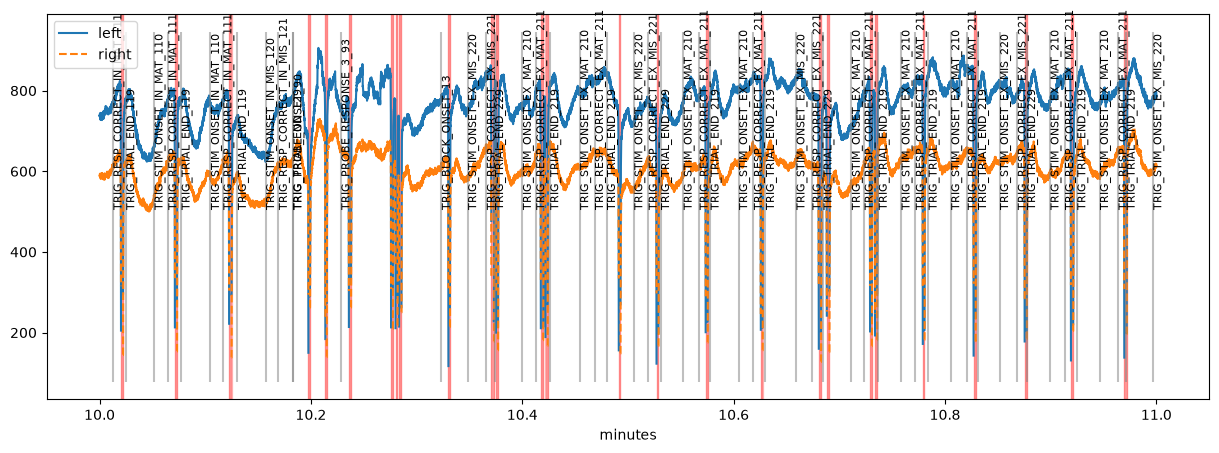
The result is an EyeData object containing all the samples and events. Here we plot the pupil data for minutes 10-11. Plot ranges (and most other times in pypillometry) can be given with units, either by multiplying with a unit from pp.u or as a string such as ("10 min", "11 min"):
[5]:
plt.figure(figsize=(15, 5))
d.plot.plot_pupil(plot_range=(10, 11) * u.min, units="min");
Note: EyeData.from_eyelink() removes Eyelink’s triggers related to calibration and validation. If you want those, you can use the keyword arguments
remove_eyelink_triggers=Falseto keep thosereturn_edf_obj=Trueto return the originaleyelinkioobject that contains all information (including saccade detection etc.)
[6]:
d, edfobj = pp.EyeData.from_eyelink(private_url, session=session,
                                    cache_file="example_data/private.edf",
                                    return_edf_obj=True)
edfobj
pp: 14:37:35 | INFO     | fetch_url:448 | Using cached copy of 'https://osf.io/5vkj3/download': example_data/private.edf
pp: 14:37:35 | INFO     | _read_edf:730 | Loading EDF file: example_data/private.edf (current log level: INFO, set to DEBUG to see eyelinkio output)
pp: 14:38:05 | INFO     | from_eyelink:1639 | Filtering out Eyelink triggers
[6]:
<EDF | private.edf>
  Version: EYELINK II 1
  Eye: BINOCULAR
  Pupil unit: PUPIL_AREA
  Sampling frequency: 1000.0 Hz
  Calibrations: 4
  Length: 1905.643 seconds
[7]:
edfobj["discrete"]
[7]:
{'messages': array([(   0.   , b'!CAL \n>>>>>>> CALIBRATION (HV9,P-CR) FOR LEFT: <<<<<<<<<'),
        (   0.   , b'!CAL Calibration points:  '),
        (   0.   , b'!CAL -15.8, -58.2         0,    264   '), ...,
        (1875.54 , b'TRIG_TASK_END_253'),
        (1905.633, b'TRIG_SESSION_END_249'), (1905.642, b'RECORDING_STOP')],
       shape=(1561,), dtype=[('stime', '<f8'), ('msg', 'S260')]),
 'buttons': array([(0., 0.), (0., 0.), (0., 0.), (0., 0.)],
       dtype=[('stime', '<f8'), ('buttons', '<f8')]),
 'inputs': array([(0., 0.), (0., 0.), (0., 0.), (0., 0.)],
       dtype=[('stime', '<f8'), ('input', '<f8')]),
 'fixations': array([(0., 7.000000e-03, 2.590000e-01,  971.09997559, 628.5       ),
        (1., 1.000000e-02, 2.590000e-01,  986.29998779, 627.59997559),
        (1., 3.190000e-01, 4.480000e-01,  644.40002441, 532.20001221), ...,
        (1., 1.905359e+03, 1.905453e+03, 1068.19995117, 514.79998779),
        (0., 1.905515e+03, 1.905641e+03,  853.5       , 488.5       ),
        (1., 1.905506e+03, 1.905641e+03,  858.70001221, 567.40002441)],
       shape=(8342,), dtype=[('eye', '<f8'), ('stime', '<f8'), ('etime', '<f8'), ('axp', '<f8'), ('ayp', '<f8')]),
 'saccades': array([(1., 2.600000e-01, 3.180000e-01,  978.70001221, 627.09997559,  655.09997559, 535.70001221, 349.5       ),
        (0., 2.600000e-01, 3.490000e-01,  974.        , 628.29998779,  651.90002441, 494.1000061 , 265.3999939 ),
        (1., 4.490000e-01, 5.050000e-01,  649.70001221, 530.20001221,  405.79998779, 517.59997559, 295.70001221),
        ...,
        (1., 1.905350e+03, 1.905358e+03, 1027.19995117, 563.5       , 1043.90002441, 545.40002441,  76.90000153),
        (1., 1.905454e+03, 1.905505e+03, 1074.80004883, 502.70001221,  873.90002441, 562.79998779, 474.3999939 ),
        (0., 1.905452e+03, 1.905514e+03, 1045.90002441, 441.20001221,  852.40002441, 488.70001221, 352.        )],
       shape=(8340,), dtype=[('eye', '<f8'), ('stime', '<f8'), ('etime', '<f8'), ('sxp', '<f8'), ('syp', '<f8'), ('exp', '<f8'), ('eyp', '<f8'), ('pv', '<f8')]),
 'blinks': array([(1.,    7.771,    7.866), (0.,    7.769,    7.867),
        (1.,   12.847,   12.948), ..., (1., 1904.197, 1904.301),
        (0., 1905.097, 1905.194), (1., 1904.869, 1905.205)],
       shape=(1114,), dtype=[('eye', '<f8'), ('stime', '<f8'), ('etime', '<f8')])}